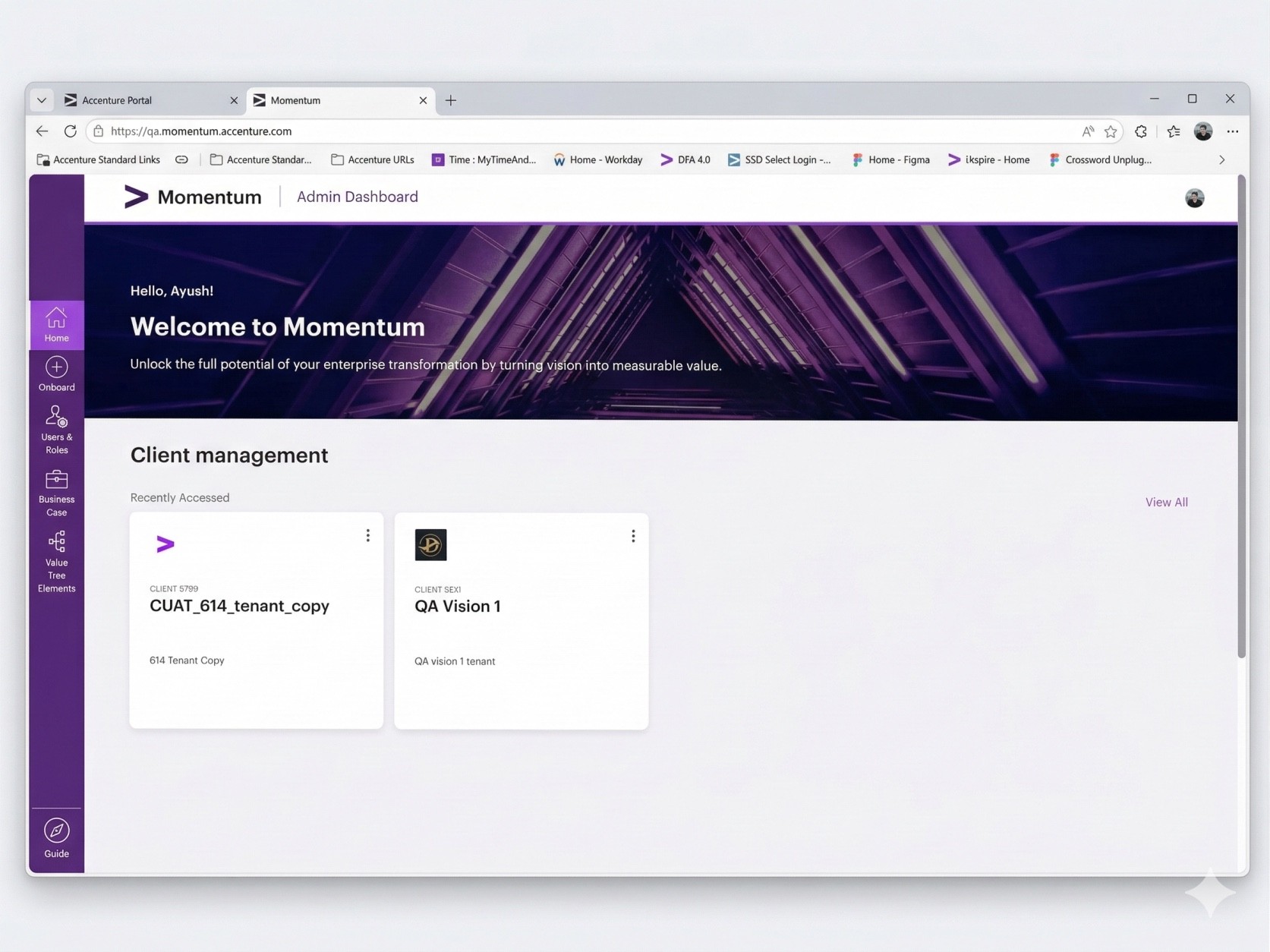
About: Momentum platform
A client-facing platform designed to help organizations align strategic goals, track transformation initiatives, and measure progress across large-scale programs.
my role
Client
Duration
Tools
Figma
Adobe XD
Jira
Microsoft Suite
contribution
UX Conceptualisation
UI Creation
Hi-fi Prototyping
UX Audits & Reviews
User Interviews
Team
Srinivasulu, BA Senior Manager
Sathish Kumar, UX Manager
Qural, UX Associate Manager
Anudeep More, UX Specialist
Akriti, UX Designer
Ved, UX Designer
Prathana, UXR
Vidushi, UXR, Interviewer
NDA Notice 🔒
Due to confidentiality agreements, I’m unable to publicly share detailed product interfaces or sensitive internal workflows from this project. Certain visuals have been intentionally blurred or simplified.
Please feel free to reach out to me to view whole project, Contact me.
my work across the platform
Rather than working on a single feature, I contributed across multiple areas of the platform. My work focused on improving clarity, consistency, and usability while supporting the product's evolution as it scaled.
Over nine months, I worked closely with product managers, engineers, and fellow designers to improve key parts of the experience.

design contribution 01:
dimension's piller- Making Transformation Progress Easier to Understand
One of the areas I worked on was helping users make sense of transformation data spread across different dimensions.
As transformation programs grow, information naturally becomes more complex. Users needed a quicker way to understand what was progressing well, what required attention, and how different focus areas were performing.
Focus & Design Improvements
My work focused on improving information hierarchy, restructuring layouts, and making important information easier to identify at a glance.
The goal wasn't to reduce information—it was to make complexity feel manageable.
design contribution 02:
OKR piller
Another major focus area was the OKR experience.
Objectives and Key Results are at the center of strategic alignment, but as goals expand across teams and programs, maintaining clarity becomes increasingly important
Focus
Making goal structures easier to understand.
Improving how key results are tracked.
Simplifying goal management workflows
Designing OKR
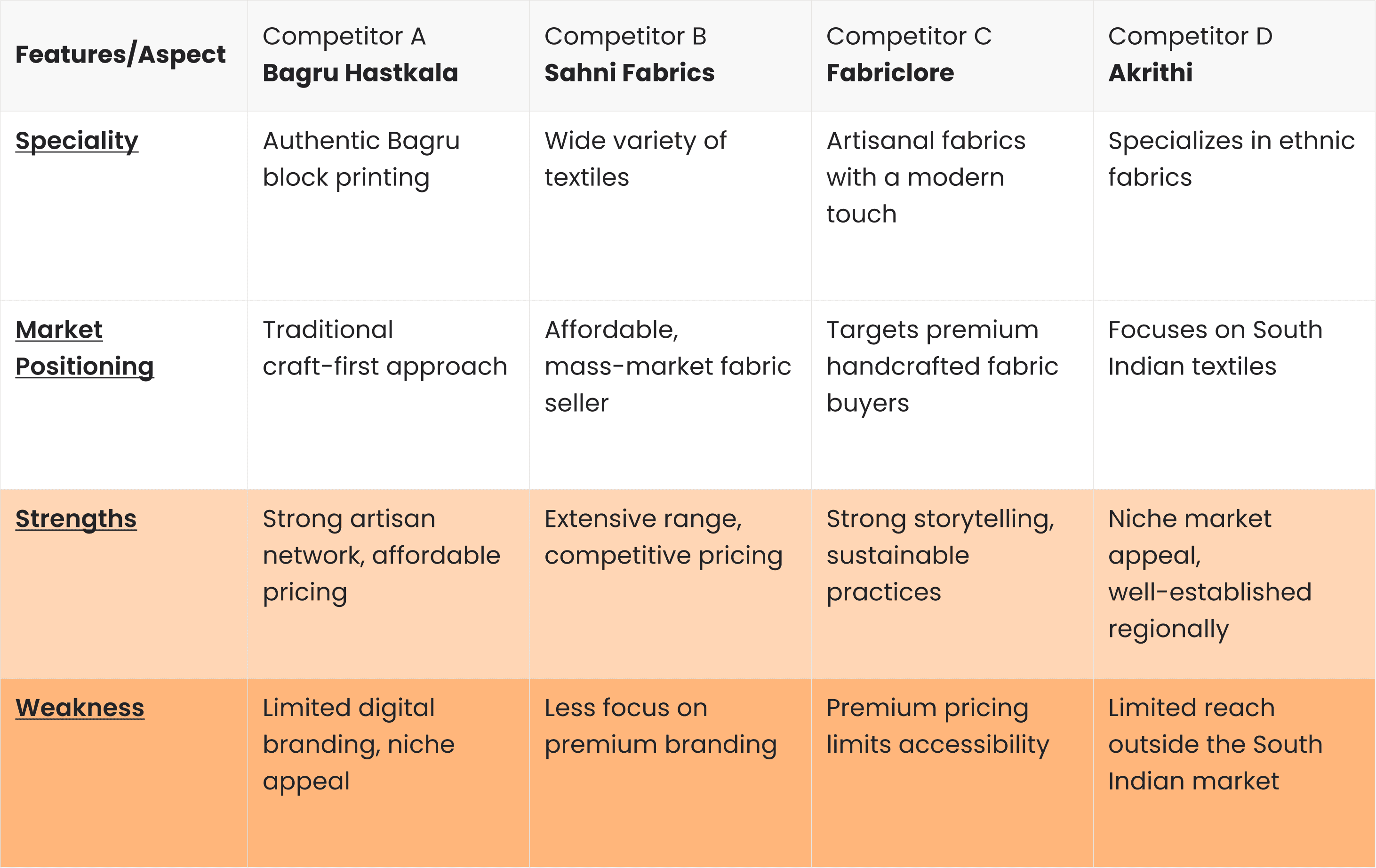
Researched and Compared Competitors with the same domain of OKR.
Designed OKR for momentum from zero with my team (whole flow inclusive of Value tree to Chart to table).
Bringing clarity to structure
We got a lot of feedback from PO & Functional team that OKR section had strong functionality, but the relationship between objectives and key results wasn’t always immediately clear.
This often made tracking progress feel slightly effortful.
I focused on simplifying how these relationships are presented also making it easier to understand what belongs to what, and how progress is being measured.
To speed up exploration, I again used Figma Make and Claude AI to generate multiple layout directions for goal structures, which helped in quickly narrowing down what felt most intuitive.
From there, I refined the flows to make interactions more predictable and easier to follow.
Impact
Clearer goal hierarchy
Improved readability of progress
design contribution 03:
Momentum design system
As the platform continued to grow, maintaining design consistency became increasingly important.
I collaborated with the design team to support the development of a shared design system for Momentum.
We already have but re-designed completely from basic/zero.
Contribution
Reusable UI components.
Consistent interaction patterns.
Standardised spacing and layout rules.
Connecting components with 'Storybook' to collaborate with 'Dev team' to make there work easier.
This system helped ensure that new features across the platform could maintain visual and interaction consistency.
Creating consistency as the product scaled
As more features were being built, maintaining consistency across the platform started becoming a challenge.
While doing this, I used Claude AI & Claude Code to think through component structures and variations more efficiently. It helped in exploring how components could scale and stay consistent across different use cases.
This made it easier to align design decisions with development and reduced back-and-forth during implementation.
Impact
Improved consistency across modules
Faster design and handoff process
design contribution 04:
UX Audits & reviews
In addition to designing new features, I conducted UX audits across several areas of the platform.
The goal was to identify usability issues and improve the overall experience. (Used UX principles to figure out the same)
focus area & Outcome
By looking across multiple modules instead of individual screens, I was able to identify patterns and recommend improvements that strengthened the overall experience.
Focus Area are:
1. Interaction consistency.
2. Navigation clarity.
3. Information hierarchy
These audits helped surface opportunities for improving the platform’s overall usability and coherence.
collaboration
Working on Momentum required close collaboration with multiple teams.
Throughout the project I worked with:
Product managers
Engineering teams
Design peers
Business stakeholders
This collaboration helped ensure that design solutions remained aligned with product goals and technical constraints.
Overall progress & outcome
Due to NDA restrictions, the full product interfaces cannot be shared publicly. However, the work contributed to improvements across several parts of the Momentum platform, including:
Clearer transformation tracking experiences
Improved goal management workflows
Greater design consistency across modules
I also explored integrating AI tools into my workflow to speed up iterations, improve consistency, and support design system thinking across the product.
reflection
Designing for Momentum provided valuable experience working within a large enterprise ecosystem.
The project reinforced the importance of:
Designing for complex systems
Maintaining consistency across growing products
Collaborating closely with cross-functional teams
NDA Notice 🔒
Due to confidentiality agreements, I’m unable to publicly share detailed product interfaces or sensitive internal workflows from this project. Certain visuals have been intentionally blurred or simplified.
Please feel free to reach out to me to view whole project, Contact me.